Connected Learning in the Classroom
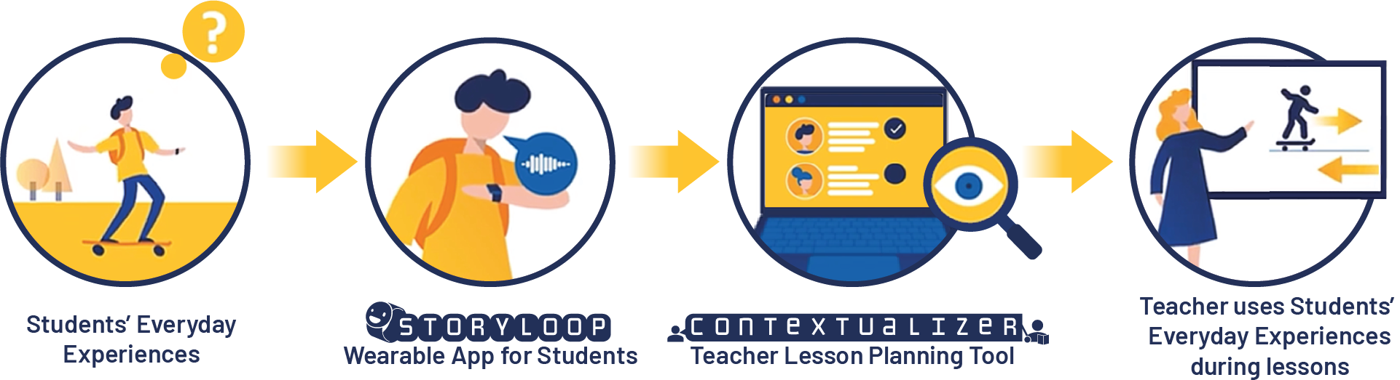
Designing a smartwatch app + teacher-portal platform (StoryLoop & Contextualizer) that lets a teacher pull students’ everyday out-of-class experiences into authentic science lessons.
Project Overview
Students disengage when classroom material feels irrelevant to their lives. "Connected learning", grounding lessons in students’ real-world experiences, is a proven solution, but teachers can’t practically do it at scale: they don’t have visibility into students’ lives outside school, and adding that work on top of pacing guides and 1-to-many class sizes is prohibitive. We set out to test whether a purpose-built technology could remove that friction.
My role. I owned the project end-to-end: I translated the pedagogy into four concrete design requirements, designed and helped build the two-sided platform (a WearOS smartwatch app and a React teacher portal on a Firebase backend), then designed and ran a two-week deployment in a real classroom and led the mixed-methods analysis.
The impact. The teachers successfully ran connected learning for the first time: they created 15 capture prompts and wove 41% of the experiences students shared into live instruction using four distinct strategies we identified. These strategies that now serve as reusable templates. The study produced eight prioritized design recommendations for connected-learning systems and, critically, revealed how teachers re-appropriate tools in the wild, reshaping the product roadmap.
The Challenge
Connected learning almost always lives in after-school or purpose-built programs, not ordinary classrooms because the everyday realities of a formal school (standards, tight schedules, high student-teacher ratios) make it too costly for a teacher to gather and act on students’ out-of-school experiences. The open question was whether technology could bridge in-school and out-of-school life without adding to the teacher’s load, and what such a system actually needs to do.
Core questions we needed to answer
- How would a teacher set up prompts to collect the right everyday experiences?
- Would students actually capture and share experiences on a wearable and how?
- How does a teacher select from and integrate student experiences into instruction?
- How do students and the teacher perceive the value of a connected-learning approach?
Methodology
We grounded the design in four requirements (rapid prompting, simple capture, efficient selection, seamless integration) and then chose an authentic in-the-wild deployment over a lab study because the core research risk was whether the approach survives real classroom constraints. We triangulated behavioral logs with qualitative accounts so we could compare what people said with what they actually did.
Two-sided system design & build
Why Connected learning has two very different users with opposing needs. Students want near-zero friction to capture, teachers want control and curation. A single interface can’t serve both.
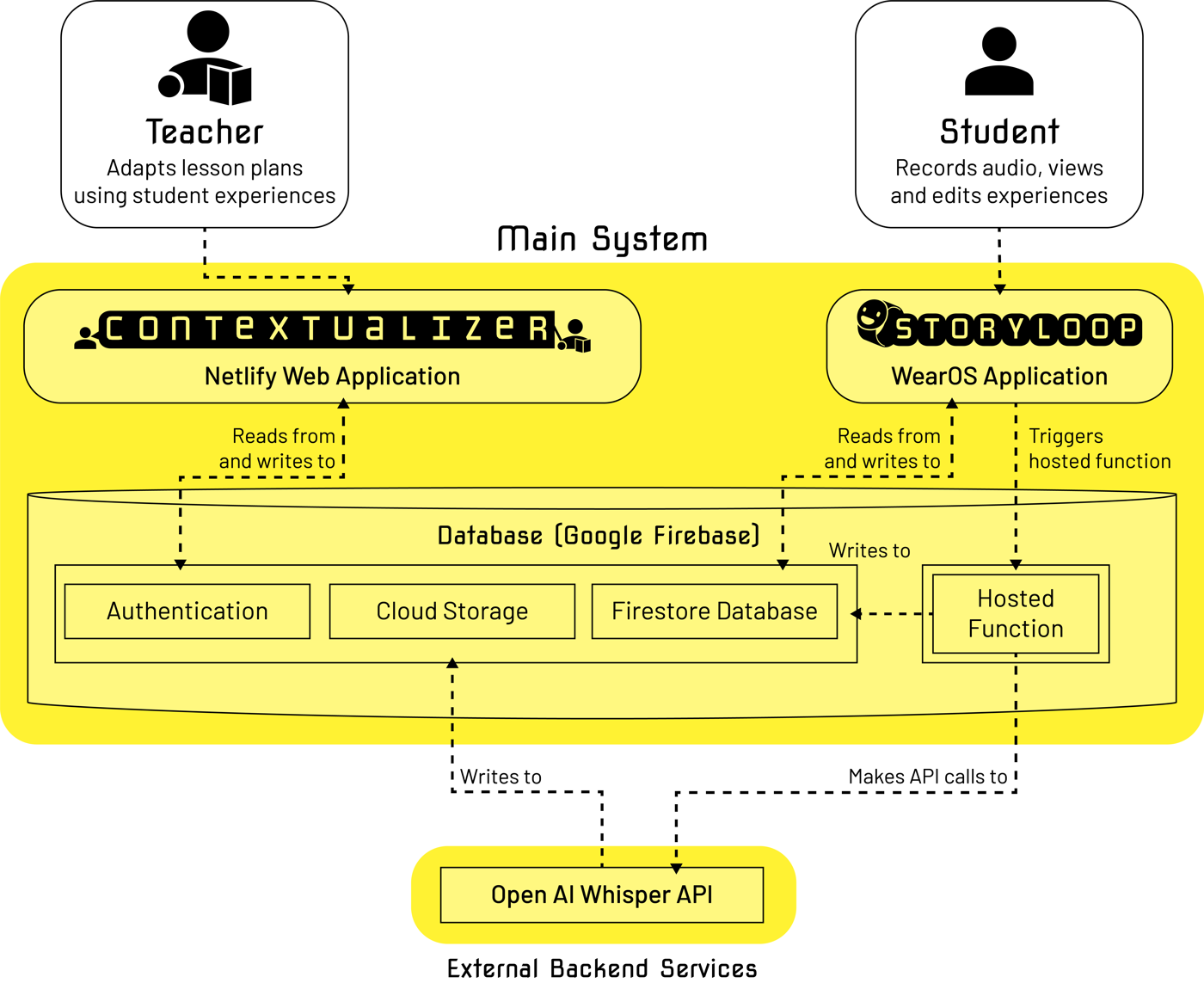
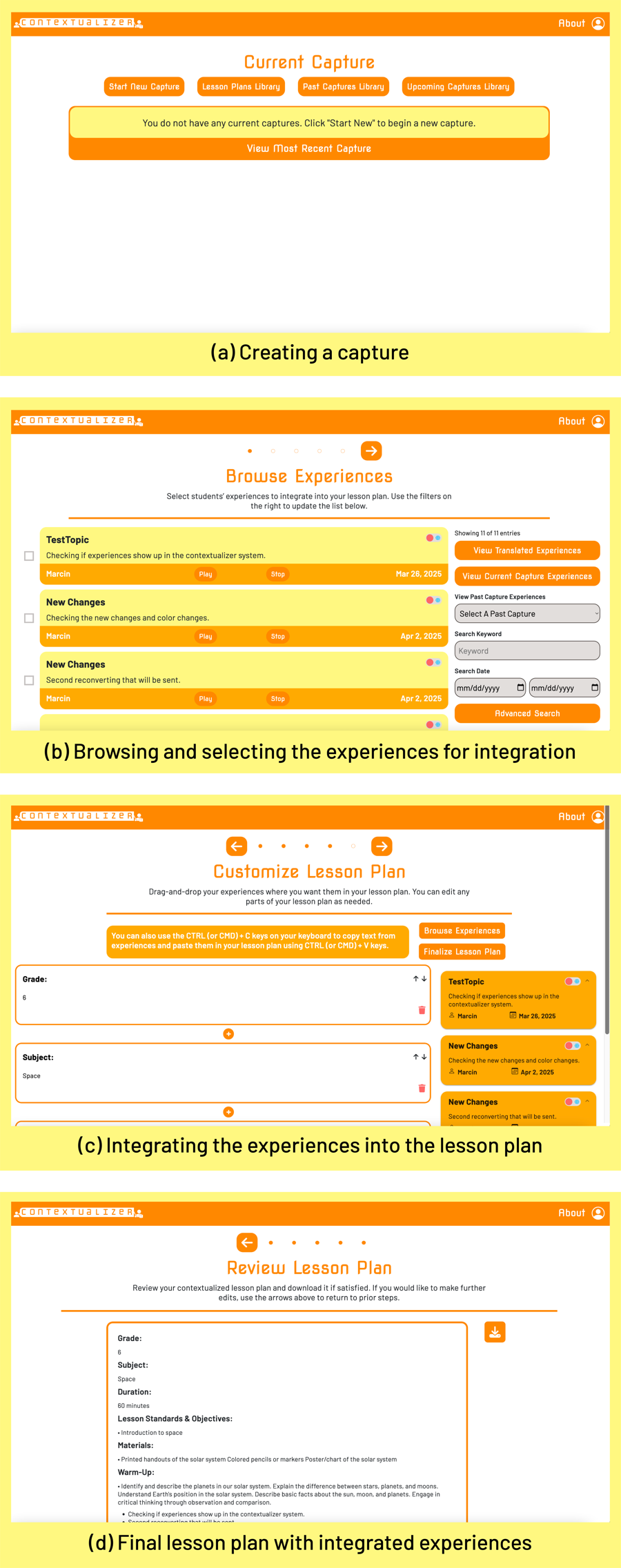
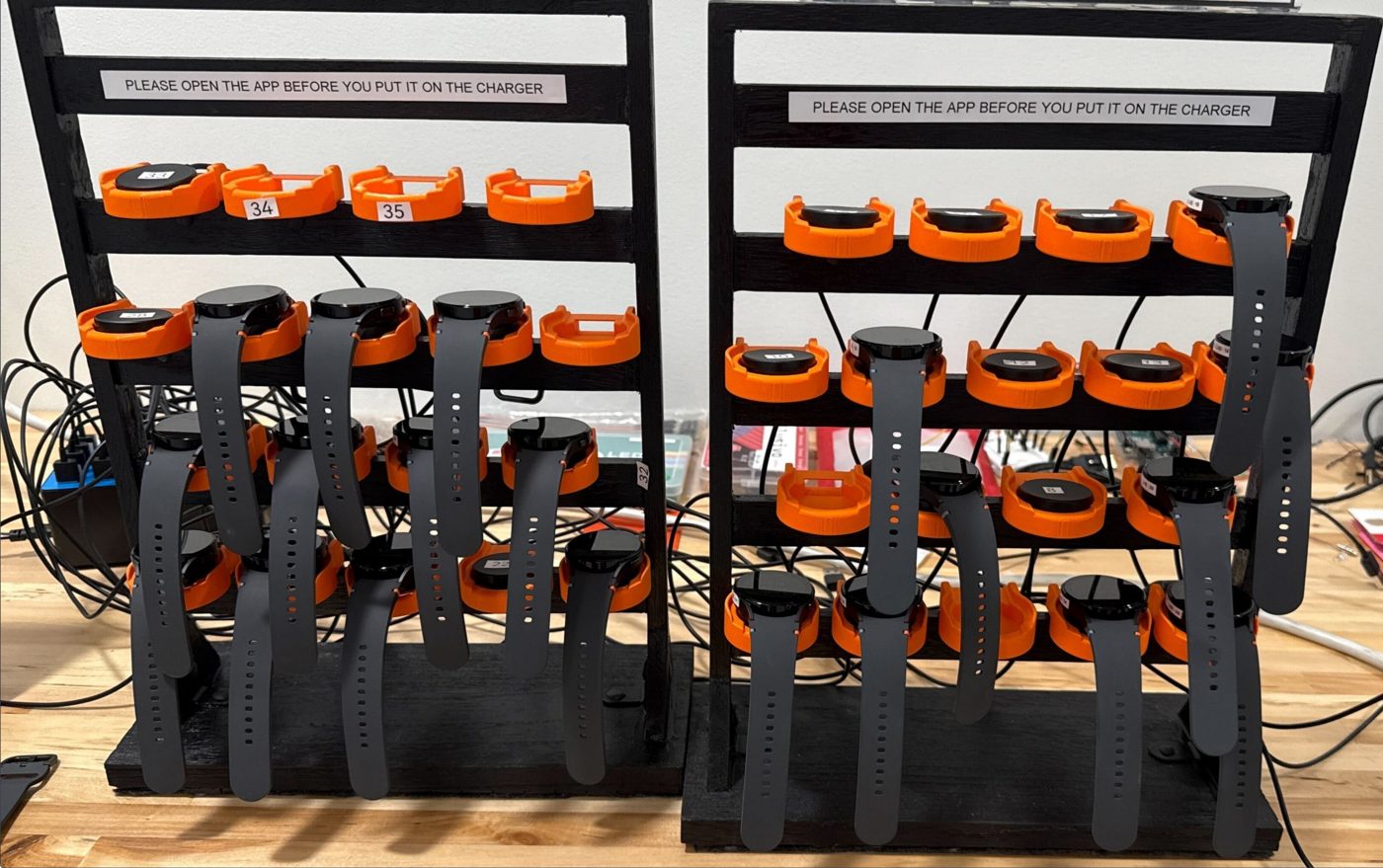
How Designed StoryLoop (a wrist-worn voice-capture app that removes the "take out your phone" barrier) and Contextualizer (a teacher portal to prompt, filter, and drag experiences into lesson plans), connected through a Firebase backend with automated OpenAI Whisper transcription.
Two-week authentic field deployment
Why The research question was about fit with real constraints. We gave the teachers complete autonomy over when and how they used the platform so we could observe genuine adoption.
How Ran the system across four grades for two weeks, with researchers as passive observers, two cameras and two audio recorders per class, plus instrumented logging of every button press and teacher action.
Mixed-methods triangulation
Why Self-report and behavior often diverge; we needed both the "what" (usage patterns) and the "why" (intent and perception).
How Analyzed 2,506 logged smartwatch actions (grouped into use sessions and visualized), coded 22 shared experiences against a typology, mapped 9 in-class integration moments from video, and thematically coded hour-long teacher and student interviews.
Key Insights & Artifacts
A wearable made capture low-friction - but motivation, not usability, was the ceiling.
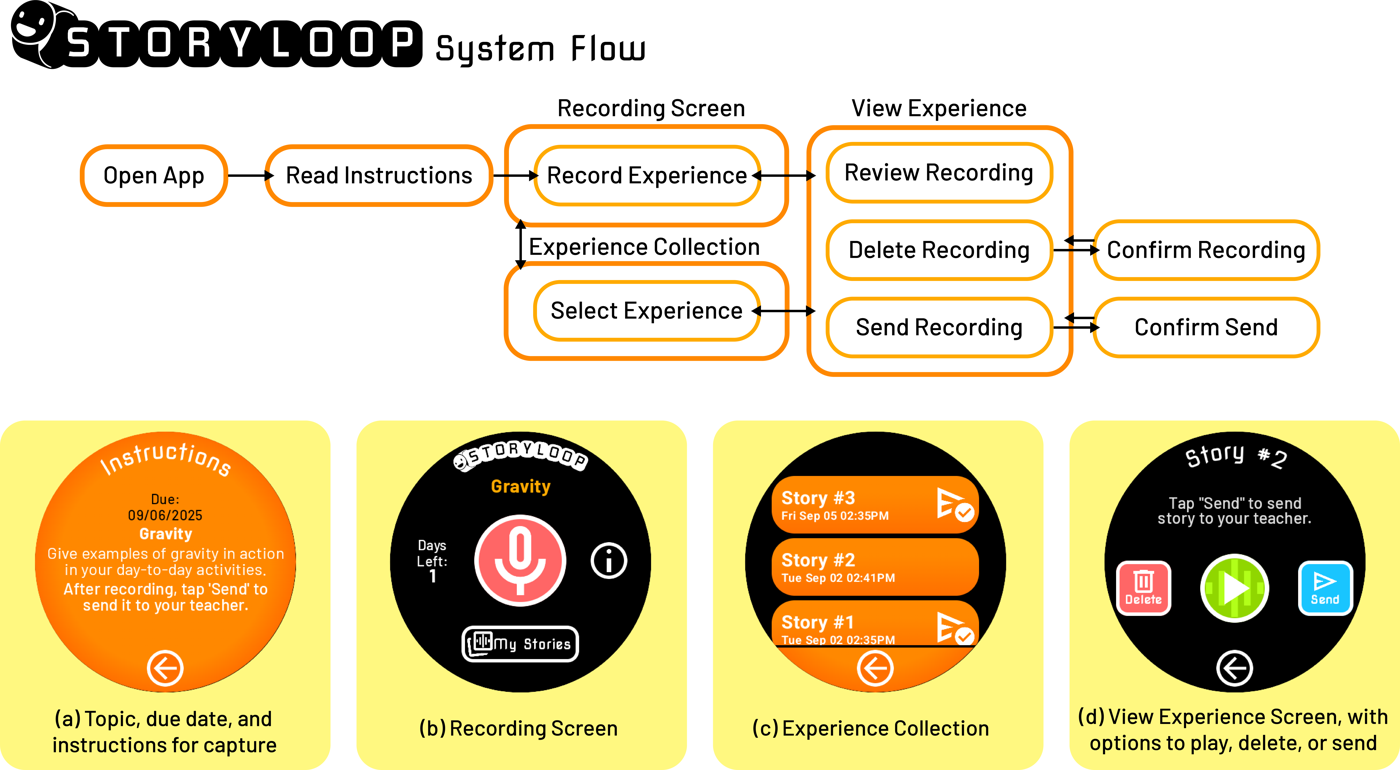
Students embraced the wrist form factor ("especially having it on the wrist instead of a phone you take out of your pocket") and we identified two distinct usage personas from the logs - "instant determinations" (decide to send/delete immediately) vs. "clustered action types" (batch one action at a time to reduce cognitive load). Yet total submissions were low (22) and declined sharply after the initial novelty.
Decision Usability was solved; sustained engagement was not. This redirected the roadmap away from interface polish and toward a motivational layer (streaks, prompts, extra-credit) as the highest-leverage next investment.
Teachers integrate experiences in patterned ways - we turned that into a reusable playbook.
From video of live instruction we distilled four repeatable strategies the teacher used to fold student experiences into lessons: Share-Only (acknowledge voice), Model-Quality (use as an exemplar), Clarify/Correct (a teachable moment), and Connect/Extend (a springboard to new concepts). Integration reliably happened during the class warm-up.
Decision These four strategies became design templates: the selection interface should adapt to the teacher’s intended strategy, and outputs should drop straight into a present-in-class format - a concrete, prioritized feature direction.
Adoption diverged from design - the "misuse" was the most valuable signal.
The platform was built for out-of-class experiences, yet the teachers used it heavily for in-class capture (voicing observations during labs), and they abandoned the built-in lesson-planner in favor of copying experiences into a Word doc to project. Trust in the classroom also emerged as a precondition for students to share at all.
Decision Rather than a failure, this exposed the true job-to-be-done: giving every student a fast voice and getting curated content onto the projector. It argues for flexible, emergent-use design and for meeting teachers inside their existing tools instead of replacing them.
Impact & Learnings
How the team applied the findings
The teacher enacted connected learning for the first time in her 25-year career, reporting deeper questioning and richer discussion. Findings were formalized into a requirements-to-recommendations map that directly shapes the next build.
- 15 capture prompts created; 41% of shared experiences integrated into instruction.
- Four integration strategies uncovered and turned into reusable teacher-facing templates.
- Five perception themes (trust, "seeing science" everywhere, enjoyment, community, perceived instructional quality) evidencing value beyond metrics.
- Eight prioritized design recommendations spanning prompting, capture, selection, and integration.
What I learned
Instrumented logs plus video were essential - the divergence between what the teacher said and what she did (in-class use, the Word-doc workaround) was the study’s richest insight and would have been invisible in a lab or from interviews alone. I also learned to design for re-appropriation: teachers will bend a tool to their rhythm, and that’s a feature to support.
What I would do differently
I’d run it longer than two weeks to separate value from novelty, bake a motivation system into StoryLoop from day one, and add a lightweight learning-outcome measure so I could tie engagement to actual understanding rather than perception alone.